Sheriff Winton
The ThicketSheriff Winton is a lawman defined by the uneasy overlap of public authority and private damage. When the exhausted group brings Fatty Worth into the sheriff’s office, Winton is lying on a cot in one of the two cells, but wakes quickly and immediately studies everyone who has entered, including Fatty Worth, Shorty, Eustace Cox, Jimmie Sue, Jack Parker, and Hog. His first appearance establishes him as both an official presence and a man whose body records a violent past.
Identity and Appearance
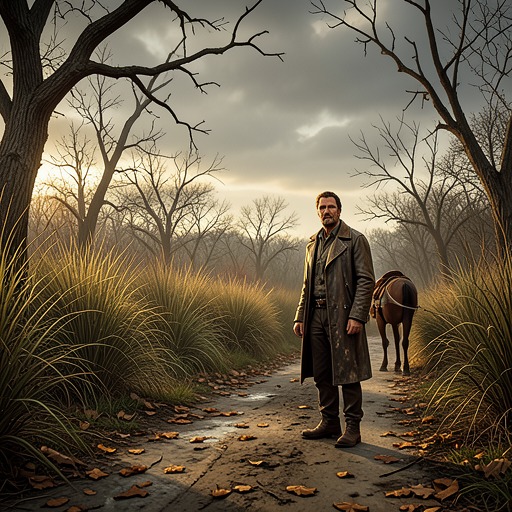
Winton is lanky, with a face that seems easier to remember from a distance. One eye leaks from hay fever; his nose flags to one side; deep scars outline his mouth; and one ear is missing. Oily hair, parted to one side, flaps over his bald head. Pink, gnarled areas on his face and scalp initially resemble scabbing, but closer inspection identifies them as burned-over skin that has ribbed up in places. The description makes his authority inseparable from visible injury: he does not enter the narrative as an abstract representative of law, but as a damaged survivor whose appearance provokes attention before his history is known.
A telephone hangs on the wall behind him, the first one Jack Parker has ever seen in person, although Jack recognizes it from photographs in the Sears and Roebuck catalog. The object places Winton’s office at the edge of technological change, while Winton himself resists the same movement. His office therefore holds two contrasting signs of modern authority: the new telephone and the old, battered sheriff who does not welcome alteration.
Office, Authority, and Resistance to Change
Winton’s manner is practical and unsentimental. When Shorty fills out papers with a feather pen dipped into a small bottle of ink, Shorty mentions that fountain pens now exist and suggests that Winton acquire one. Winton declines because he does not like change. He regards the telephone and the few places it connects around town as already more modernity than he wants to manage.
That resistance is not simple incompetence. Winton knows what his office requires and recognizes that the group is likely to leave quickly in pursuit of the others. He also knows that he may go with them, making the paperwork unnecessary. His official role is thus presented as flexible rather than bureaucratic: the sheriff can suspend routine procedure when the larger pursuit demands movement. The exchange also preserves his dry, blunt character. He does not romanticize his position, but neither does he abandon it.
Earlier Life and the Comanche Frontier
Winton’s history emerges indirectly through Shorty’s recollection beside a fire. Before becoming sheriff, Winton was a bounty hunter. Before that, he attempted to settle a ranch in North Texas, a region Shorty describes with contemptuous humor as a place that could be improved with rubble and barn-floor scrapings. The setting is also identified as Comanche country, though the Comanche people’s territory was more broadly dispersed; North Texas was one of their haunts as they moved as buffalo-hunting nomads.
This background places Winton inside a frontier order already undergoing collapse. Shorty explains that the Comanche were near the end of their world without necessarily accepting that fact. White men were arriving in large numbers with better weapons, while the buffalo, the source that functioned as the Comanche’s general store, were nearly gone. Even under those pressures, Shorty insists that the Comanche remained formidable. Winton’s former ranching effort therefore belongs to a contested landscape shaped by conquest, disappearing resources, and unequal weaponry, rather than to a neutral wilderness.
From Bounty Hunter to Sheriff
The sequence of Winton’s occupations—ranch settler, bounty hunter, sheriff—suggests a career repeatedly reorganized by frontier violence. The evidence does not present him as a stable civic founder who naturally progresses into office. Instead, each role follows an earlier attempt to survive or impose order in a harsher environment. His burned skin, missing ear, scars, and bald, ridged scalp give physical form to that history without explaining every wound individually.
His conversion from bounty hunter to sheriff also creates an important tension in his authority. A bounty hunter pursues people for payment; a sheriff acts under public responsibility. Winton carries the habits and bodily consequences of the former role into the latter, so the badge does not erase the violence that preceded it. When he later considers joining the pursuit, the decision recalls the mobility of the bounty hunter even as he insists on the identity of the sheriff.
Decision to Join the Pursuit
Winton tells the group that he is thinking of going with them after the people they are pursuing. Shorty stops writing and reminds him that he is no longer a bounty hunter, asking why he would go. Winton answers that he is a sheriff and that the group may need someone like him. The statement is more than a declaration of professional duty. It is a self-definition: Winton frames participation not as a return to bounty hunting, but as an extension of the obligations attached to his current office.
The decision changes his position from stationary authority to traveling ally. Until that moment, the sheriff’s office is a place where the group deposits Fatty Worth and encounters local law. Winton’s proposed departure breaks that boundary. He chooses to leave the desk, cot, cells, telephone, and paperwork behind, carrying his damaged body and hard-earned frontier knowledge into the dangerous movement beyond town.
Narrative Role and Significance
Winton functions as a threshold figure between settled law and the violent country outside it. His office contains paperwork, ink, cells, and a telephone, yet his personal history leads back to ranching, bounty hunting, and Comanche territory. That contrast makes him a living link between incompatible versions of order: formal law on one side, improvised survival on the other.
His physical description and biography also complicate the idea that law represents safety. Winton is not untouched by the violence he helps regulate; violence has marked his face, removed an ear, and burned his skin. Nevertheless, he remains capable of judgment and action. His refusal of the fountain pen signals resistance to change, but his willingness to join the pursuit shows that resistance does not mean passivity. Winton’s significance lies in that contradiction: he is an old-fashioned sheriff who cannot remain enclosed within the old world, because the world that made him is already moving beyond the limits of his office.